

You're usually reading about how to verify insurance because something already broke. A claim denied for inactive coverage. A surgery that should've been authorized but wasn't. A payer that insists the patient was out of network at the facility even though the card looked fine at registration. The front desk says they checked it. Billing says there's no usable proof. Operations ends up eating the rework.
That's the gap most workflows miss.
Insurance verification isn't a courtesy task and it isn't just a patient access step. In a functioning revenue cycle, it's a documented, repeatable control that protects claims before service, supports appeals after service, and gives leadership a clean line of sight into where denials start. If you run specialty volume, that distinction matters more than many realize.
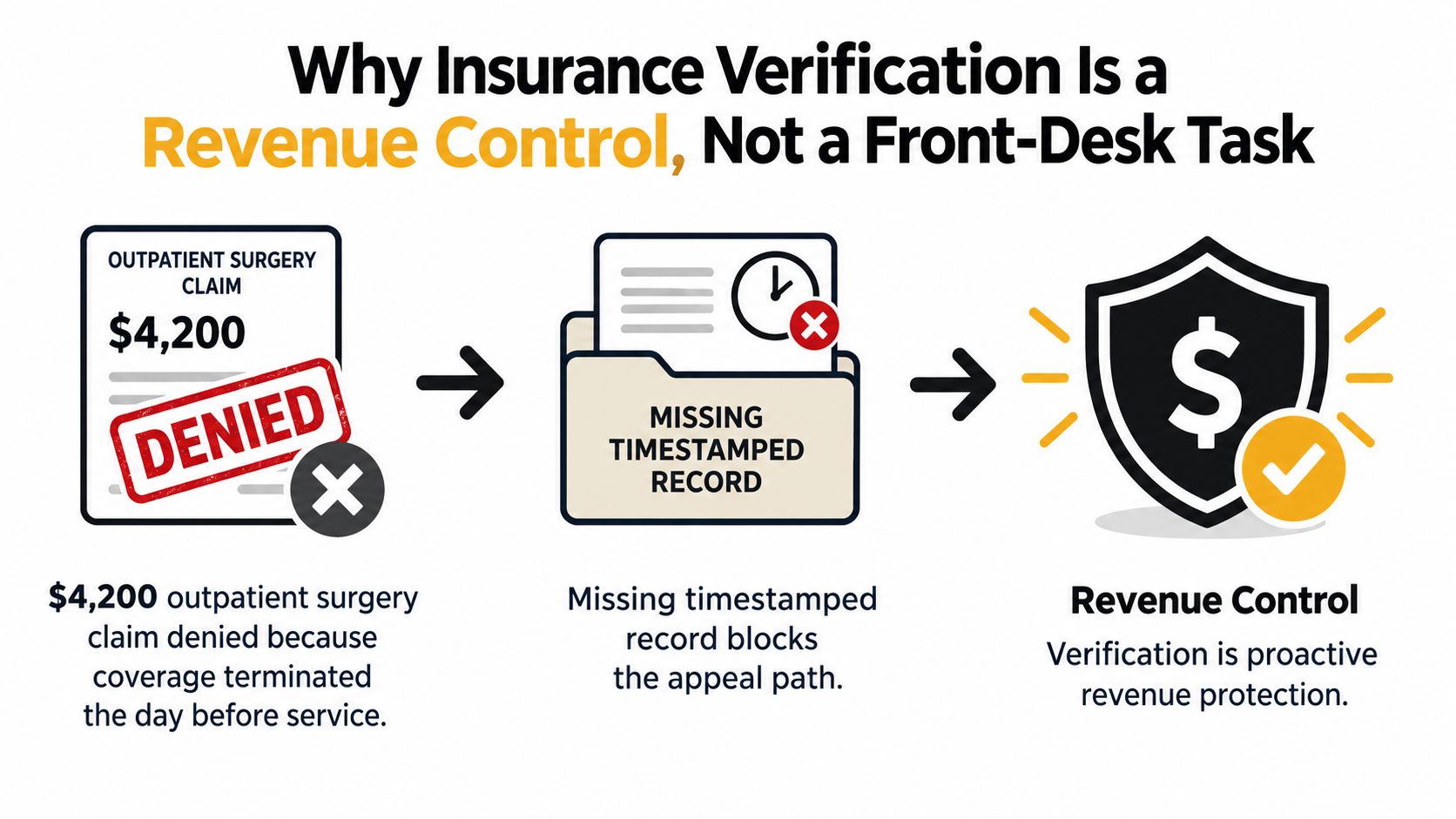
Why Insurance Verification Is a Revenue Control, Not a Front-Desk Task
The schedule looks clean on Tuesday afternoon. By Thursday, billing is holding a high-dollar claim because the plan terminated two days before surgery, the replacement product routes to a different payer, and nobody saved proof of what was checked at scheduling. The visit happened. The revenue is now exposed. That is what weak verification looks like in production.
Verification works as a revenue control when it is documented, repeatable, and tied to the encounter. Teams should be able to show what was checked, when it was checked, which source was used, what came back, and who owned the next step. That standard protects cash before service and gives the business something usable after service if the payer reverses position.
What a real control has to do
A real verification control does three things well.
It prevents avoidable claim defects before the patient is seen. That includes inactive coverage, bad member IDs, COB errors, referral gaps, network mismatches, and benefit limits that apply to the actual service, provider, and location.
It creates timestamped evidence that can be rerun and defended. One major health IT eligibility workflow records checks by date, returns recent inquiries from the last 30 days, and can retain prior submitted eligibility records for up to 6 months, as described in athenahealth's eligibility history workflow. That is the right model. Verification should leave a record strong enough for payer disputes, appeals, and NSA IDR files when payment turns on what coverage or network status existed on a specific date.
It feeds operational corrections upstream. If the same payer keeps failing at a certain site of service, or a specialty keeps missing PCP referrals on HMO plans, the fix belongs in scheduling scripts, intake rules, and auth workflows. Leaving that pattern in bill follow-up guarantees rework.
Practical rule: A verification result should be reproducible, timestamped, and attached to the encounter. That is what makes it a dependable revenue control.
Why specialty groups get hurt faster
Specialty revenue breaks faster because the claims carry more conditions. Timing matters more. Authorization rules are tighter. Network participation can vary by rendering provider, facility, and product. Benefit limits often depend on the exact service, not just whether the patient has active coverage.
I have seen office-based specialties survive loose eligibility habits longer than imaging, ASC, infusion, oncology, cardiology, and hospital-based procedural work. Those settings usually do not get a second chance. Once the date of service passes with the wrong plan, wrong auth path, or wrong network assumption, recovery gets slower and more expensive.
The denial rates support treating verification as a KPI-driven control. A 2024 survey reported that around 15% of claims submitted to private payers, Medicare Advantage, and Medicaid managed care plans are initially denied, and separate 2026 reporting on ACA marketplace claims found about 19.1% of in-network claims were denied, roughly 8.8 million denied claims out of 46 million filed across HealthCare.gov states in 2024, according to Experian's denial reporting summary. Teams should connect verification work to denial categories such as eligibility, COB, authorization, and out-of-network payment variance. Otherwise leadership sees activity, not control performance.
Dependable control requires reproducible, timestamped evidence tied to the encounter
Coverage checks fail in predictable ways:
- Front-desk-only ownership: verification happens between check-ins, with no exception queue, no escalation path, and no dedicated follow-up.
- Single-touch processing: someone checks once at booking, then the schedule changes, the DOS moves, or the payer updates eligibility and nobody reruns it.
- Weak evidence capture: portal screenshots, call references, and 271 responses never make it into the encounter record.
- No denial feedback loop: billing keeps finding the same eligibility and benefit defects, but registration, scheduling, and auth teams never change the intake rules.
Trade-offs are real. Rechecking every encounter too often adds labor. Rechecking too little shifts cost into denials, appeals, patient balance cleanup, and write-offs. The right answer is a controlled workflow with clear rerun points, evidence standards, and ownership by exception type.
Teams that want cleaner claims should manage verification the way they manage coding edits or charge review. Assign ownership. Set rerun triggers. Audit the proof. Track the denial fallout by root cause.
The Data You Must Capture Before You Verify Anything
Most verification errors start before anyone touches a payer portal or submits a 270. The team doesn't have enough correct information to ask the right question. When that happens, the workflow creates false confidence. You get a response, but not the response for the actual patient, policy, payer order, or service.
Four buckets that have to be complete
Use a hard intake standard before verification starts.
| Data Bucket | Required Fields | Common Capture Errors |
|---|---|---|
| Patient identifiers | Legal name, date of birth, relationship to subscriber, subscriber name when different, last four of SSN when allowed | Nicknames, DOB transpositions, subscriber and patient mixed together |
| Coverage identifiers | Payer name, payer ID when available, member ID, group number, plan type, primary/secondary order | Missing group number, transposed member ID, old card used, plan name captured but not actual payer |
| Encounter context | Scheduled service or CPT description, date of service, rendering provider, referring provider when required, facility or location | Generic visit type only, wrong location, missing referring provider, service not specific enough |
| Access details | Authorization status, referral status, PCP assignment for HMO products, prior auth reference number when obtained | Assuming auth isn't needed, no PCP confirmation, referral not tied to exact service |
The more specialized the encounter, the less room there is for vague scheduling notes. “Procedure consult” is not enough. “MRI” is often not enough. The verifier needs the actual service context or they can't validate the right benefits.
Questions staff should ask the patient directly
Intake scripts need to be explicit. Staff shouldn't improvise around coverage order or liability-related billing.
Use direct wording like this:
- Coverage update: “Has your insurance changed since you booked this appointment?”
- Secondary plan check: “Do you have any other active health insurance, even if this card is the one you use most often?”
- Subscriber relationship: “Are you the policyholder, or are you covered under someone else's plan?”
- Referral screen: “Did your primary care doctor send a referral for this visit or service?”
- Work injury screen: “Is today's visit related to a work injury or workers' compensation claim?”
- Other liability screen: “Is this visit related to an auto accident or another claim that may involve outside insurance?”
- Medicare coordination screen: “If you have Medicare, do you have any employer, retiree, or other health coverage in addition to Medicare?”
The verification team can only verify against the payer structure it was given. If staff never asks about secondary coverage, workers' comp, or MSP status, the denial is already in motion.
What quietly sabotages the whole process
Teams love to focus on payer complexity because it feels external. In practice, the ugly losses often come from simple intake misses.
The common ones are familiar: transposed member IDs, old cards still on file, missing group numbers, no one asking about COB, and referrals documented in free text instead of a searchable field. Another frequent problem is verifying the patient under the card image alone without confirming whether the scheduled facility, rendering provider, or service type changed after booking.
If your team is rebuilding intake discipline, start with a standardized field list and a short script. Then make those required before any verification task can close. A structured workflow, such as a medical eligibility verification process, is usually less about adding work and more about preventing bad work from moving downstream.
Choosing the Right Verification Channel for Each Payer
There isn't one perfect verification channel. There are three practical ones: EDI 270/271 transactions, payer portals, and live phone calls. Each solves a different problem. Teams get into trouble when they use all three randomly or let staff pick based on habit.
Use channel rules, not staff preference
If your goal is repeatability, set a default hierarchy. I prefer EDI first, portal second, phone third.
That's because the channel decision affects more than speed. It affects whether you can rerun the check, whether you can prove what the payer returned, and whether the verification can be audited later. If you're trying to learn how to verify insurance in a way that protects revenue, channel discipline matters as much as staff accuracy.
| Channel | Strength | Limitations |
|---|---|---|
| EDI 270/271 | Structured response, timestamped trail, scalable for repeat checks | Some payers return thin data, stale data, or incomplete benefit details |
| Payer portal | Useful benefit detail, plan-specific notes, visibility into payer quirks | Screenshot burden, weaker standardization, some results are hard to reproduce cleanly |
| Live phone call | Best for disputed answers, unusual benefit limits, complex COB | Slowest option, hard to scale, dependent on rep quality and documentation |
Where each channel actually works best
EDI should be the default for baseline eligibility and for any workflow that needs a durable transaction record. It's the cleanest starting point for repeat checks and appeals support.
Portals are often better when the 271 doesn't return enough detail for the planned service. That happens with carve-outs, service-level exclusions, referral rules, and plan wrappers that don't translate well into a generic transaction.
Phone should be reserved for exceptions. Use it when EDI and portal responses conflict, when you're dealing with odd COB sequencing, or when the payer's benefit structure is too nuanced to trust to a generic electronic return.
The trade-off most teams miss
Portal-heavy teams often move fast in the moment but create weak records. Phone-heavy teams collect nuance but produce expensive labor and inconsistent proof. EDI-heavy teams gain structure, but only if they know when the 271 response is incomplete and shouldn't be treated as final.
Operator's view: The best workflow doesn't pick one channel. It defines when to stop trusting one channel and escalate to the next.
A clearinghouse-centered setup usually makes this easier because it gives the team one repeatable lane for most payers, then flags the exceptions that need portal or phone follow-up. For organizations tightening front-end controls, the operational value of a clearinghouse in medical billing is consistency, not just connectivity.
Payer quirks should live in a reference library, not in people's heads. If one Medicaid MCO requires portal confirmation even after an EDI response, write that rule down. If one commercial payer regularly returns active eligibility on the 271 but stores more accurate deductible or site-of-service detail in the portal, route that payer accordingly. Mature teams don't rely on memory. They build channel rules.
Running a Three-Checkpoint Verification Workflow
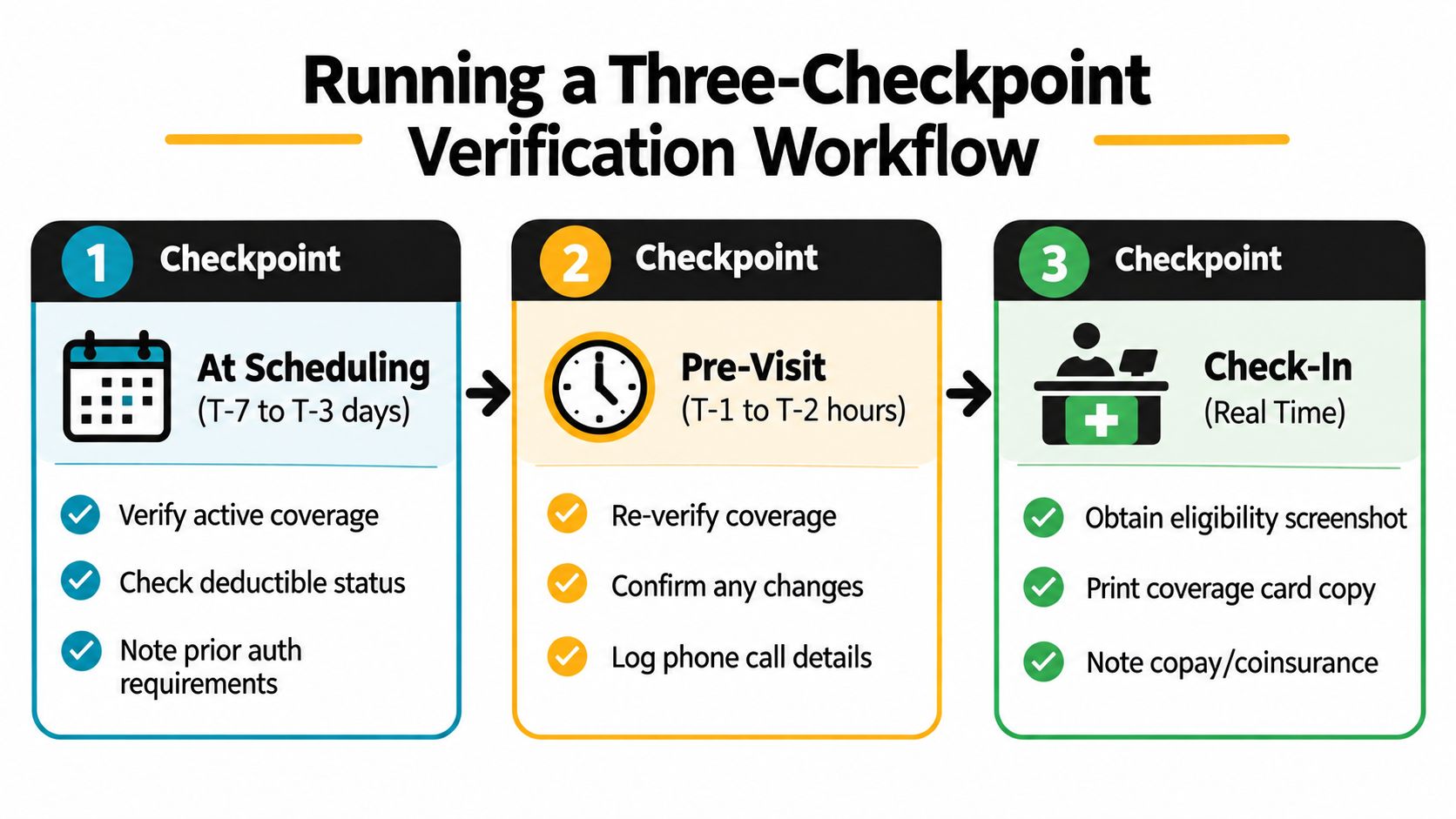
A one-touch verification model breaks because coverage and registration details change between booking and service. Independent healthcare reporting recommends three checkpoints: at scheduling, again 48 to 72 hours before the visit, and once more at check-in, because registration data can change between those moments. The same reporting noted 48% of providers said data collected at registration or check-in was somewhat or not accurate, and 56% said patient information errors were a primary cause of denied claims, according to Experian's insurance verification workflow guidance.
Checkpoint one at scheduling
This first touch is about catching obvious blockers early enough to act.
At scheduling, confirm:
- Identity match: Legal name, DOB, subscriber relationship, policy details
- Base coverage status: Active plan and payer order
- Service setup: Rendering provider, facility, and planned service
- Access dependencies: Referral or prior auth requirement indicators
Use EDI first if available. If the response is incomplete or the payer is known to require portal detail, escalate immediately. Don't wait until the day before service to discover the visit was booked under the wrong payer.
Checkpoint two before the visit
This is the re-run that saves claims. Current industry guidance emphasizes re-verifying closer to the appointment and explicitly checking active coverage on the date of service, not just whether the patient is currently enrolled. Reporting has also highlighted pressure toward 24 to 72 hour pre-service checks and even 24 to 48 hour re-verification because coverage changes and benefit exhaustion are increasingly causing avoidable denials, as summarized in TechTarget's front-end denial coverage.
At this checkpoint, re-confirm effective dates, termination dates, network status, deductible and coinsurance exposure, and outstanding auth or referral gaps. If the patient changed plans, route the account into an exception queue immediately.
Checkpoint three at check-in
Check-in is the final control, not a repeat of scheduling.
The registrar should verify that the card on hand matches what's in the system, ask whether any coverage changed since booking, and confirm the encounter is still tied to the same provider and location. If the earlier result came from a portal, save the screenshot ID or the actual image against the encounter. If it came from EDI, verify the transaction trace is stored. If it required a phone call, confirm the reference number and rep details are present.
Record these fields every time:
- Date and time of check
- Channel used
- Payer reference number when provided
- Representative name and ID for phone calls
- Portal screenshot ID or file name
- 271 transaction trace or clearinghouse control number
- Internal user ID of the verifier
- Disposition, such as verified, exception, escalated, or patient updated plan
If EDI is down, the workflow still needs a fallback. “System issue” is not a control. It's just a note explaining why no control happened.
This process has to live inside workqueues and scheduling templates. If staff must remember when to rerun eligibility, the process will fail the first busy week.
Moving Beyond Active Coverage to Real Benefit Verification
A green active-coverage response causes more false confidence than almost anything else in patient access. The patient may be enrolled and still be wrong for the claim. The plan may be active but out of network at the facility. The benefit may exclude the service category. The referral may be missing. The deductible may leave the patient exposed in ways your collections workflow never prepared for.
Eligibility is not the same as benefits
Teams that only verify active status are answering the smallest possible question. They're proving the card isn't obviously dead. They are not proving the planned service will adjudicate cleanly.
That distinction matters because provider guidance now emphasizes separate checks for active coverage on the exact date of service, member and policy accuracy, benefit limits, in-network status by site of care, prior authorization or referral rules, and coordination of benefits sequencing. It also notes that insurance may verify as active while the claim still denies because of benefit exhaustion, exclusions, wrong site-of-service network rules, or missed prior auth, as outlined in Edge RCM's verification analysis.
The fields that actually drive denials
| Benefit Field | What It Controls | Denial or NSA Exposure if Missed |
|---|---|---|
| Effective and termination dates | Whether coverage is valid for the service date | Denial for inactive coverage on date of service |
| Network status | Whether provider and facility are in network for this plan | Out-of-network denial, lower payment, patient balance disputes |
| Deductible status | Patient financial responsibility before plan payment | Undercollection or patient billing conflict |
| Copay or coinsurance | Point-of-service collection expectations | Incorrect estimate, patient complaint, avoidable balance follow-up |
| Prior authorization requirement | Whether payer approval was needed before service | Technical denial even with active policy |
| Referral requirement | Whether PCP or plan referral was required | Denial for missing referral |
| Visit or service limits | Whether service quantity or frequency is capped | Denial after limit reached |
| COB order | Which payer should process first | Wrong payer billed, preventable rejection |
| Service exclusions or carve-outs | Whether benefit exists under the plan for this service | Noncovered denial despite active enrollment |
What to capture from the response
When you're learning how to verify insurance correctly, you have to train staff not to stop at “eligible.” They need to translate payer output into structured fields the claim team can use later.
Capture, at minimum:
- Coverage dates
- Plan type
- In-network or out-of-network status
- Deductible and patient share indicators
- Referral or prior auth requirement
- Service-level limits or exclusions
- COB order
- Any payer-specific notes tied to site of care
An active response is only the first signal. The useful work starts after that.
Building Documentation That Supports NSA IDR and Appeals
Verification only protects revenue if the organization can prove what it checked, when it checked it, and what the payer returned. If a denial comes in months later, or if an out-of-network payment dispute turns into a No Surprises Act matter, vague chart notes won't carry the argument.
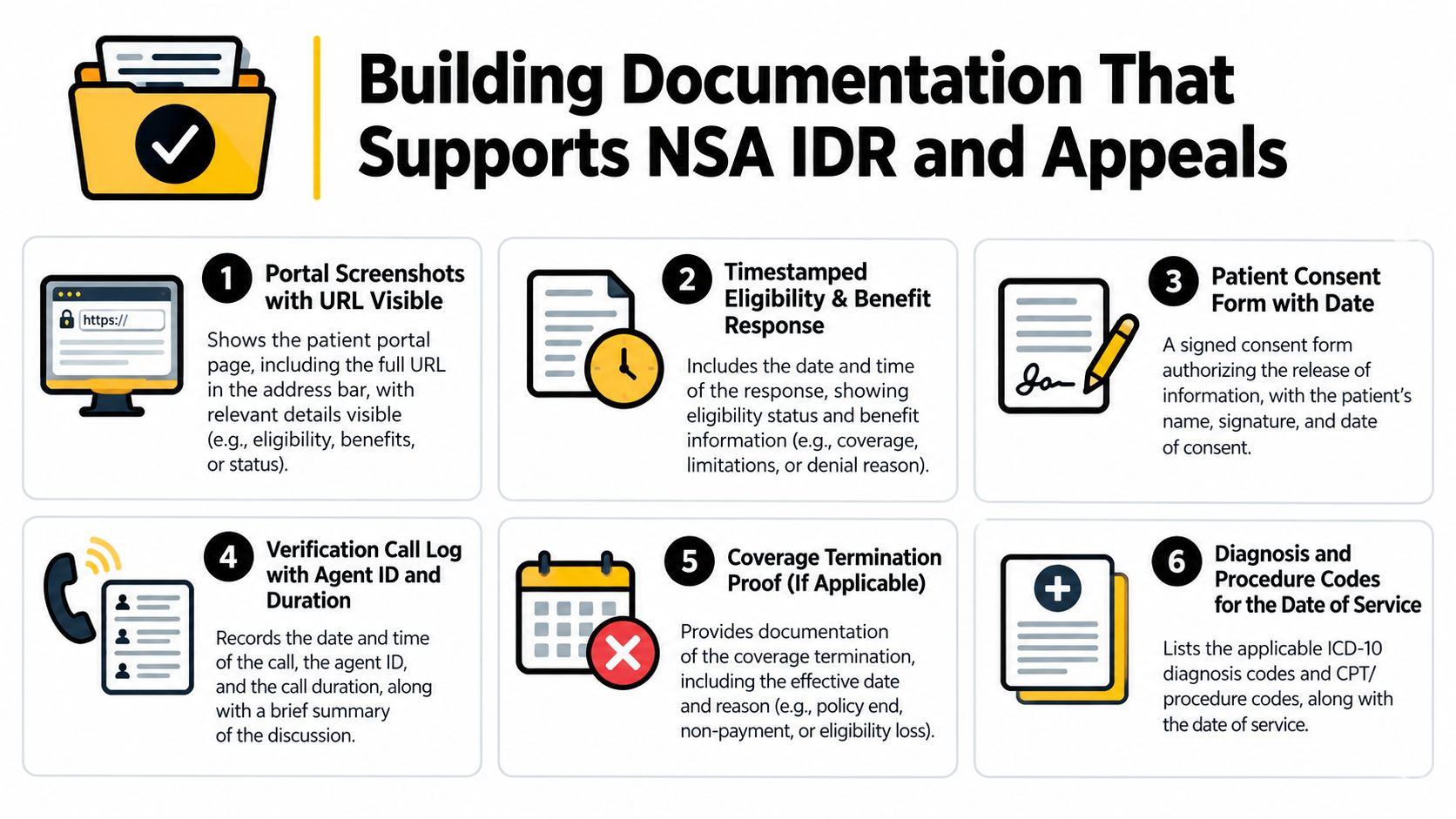
Build an encounter-level evidence packet
Every encounter that goes through verification should leave behind a usable evidence trail. Not scattered artifacts. One packet.
Store these items per encounter:
- Portal screenshots with visible timestamp and enough context to identify the payer result
- Full 270 and 271 files or the clearinghouse trace tied to that response
- Phone verification logs with call date, time, payer rep name, rep ID, and reference number
- Internal user ID showing which staff member performed or reviewed the check
- Authorization or referral proof when applicable
- Patient-facing forms used at scheduling or check-in when financial disclosures or consents matter to the dispute
- Coverage change proof when a plan terminated or changed near the service date
Index the evidence to the actual dispute
Teams save documents but don't organize them in a way appeals staff or counsel can use quickly. That's the problem.
An evidence index should tie each artifact to a specific issue, such as:
- Eligibility on date of service
- In-network or out-of-network status
- Authorization requirement and status
- COB order
- Patient notice or consent element
- Payer denial reason code or appeal point
That matters for payer appeals, and it matters even more when documentation may support downstream arbitration strategy. A team handling denials, underpayments, and federal dispute preparation needs the verification file to be complete enough to hand off without reconstruction. For organizations dealing with that layer regularly, No Surprises Act IDR support usually works best when eligibility evidence and dispute evidence are built from the same workflow rather than patched together later.
Save the raw evidence, not just the summary note. A verifier's interpretation helps. The original payer response is what survives scrutiny.
Retention and export discipline
Documentation also needs governance. Decide where these artifacts live, who can edit them, who can only view them, and how long they stay attached to the encounter based on your compliance and dispute needs.
Export should be simple. One PDF or ZIP per encounter is ideal when a claim escalates. The packet should move cleanly to billing, appeals, legal, or IDR staff without forcing them to chase screenshots across inboxes or ask access staff to recreate what happened. If the coding team or medical records team needs to support the file later, they should receive a stable evidence bundle, not a set of verbal instructions.
KPI Tracking and a Weekly Verification Checklist
Verification teams get measured the wrong way all the time. Leadership tracks total denials, A/R, and clean claims, then wonders why the verification floor doesn't know what to improve. Those outcome metrics matter, but they're lagging indicators. A verifier needs operational KPIs they can move this week.
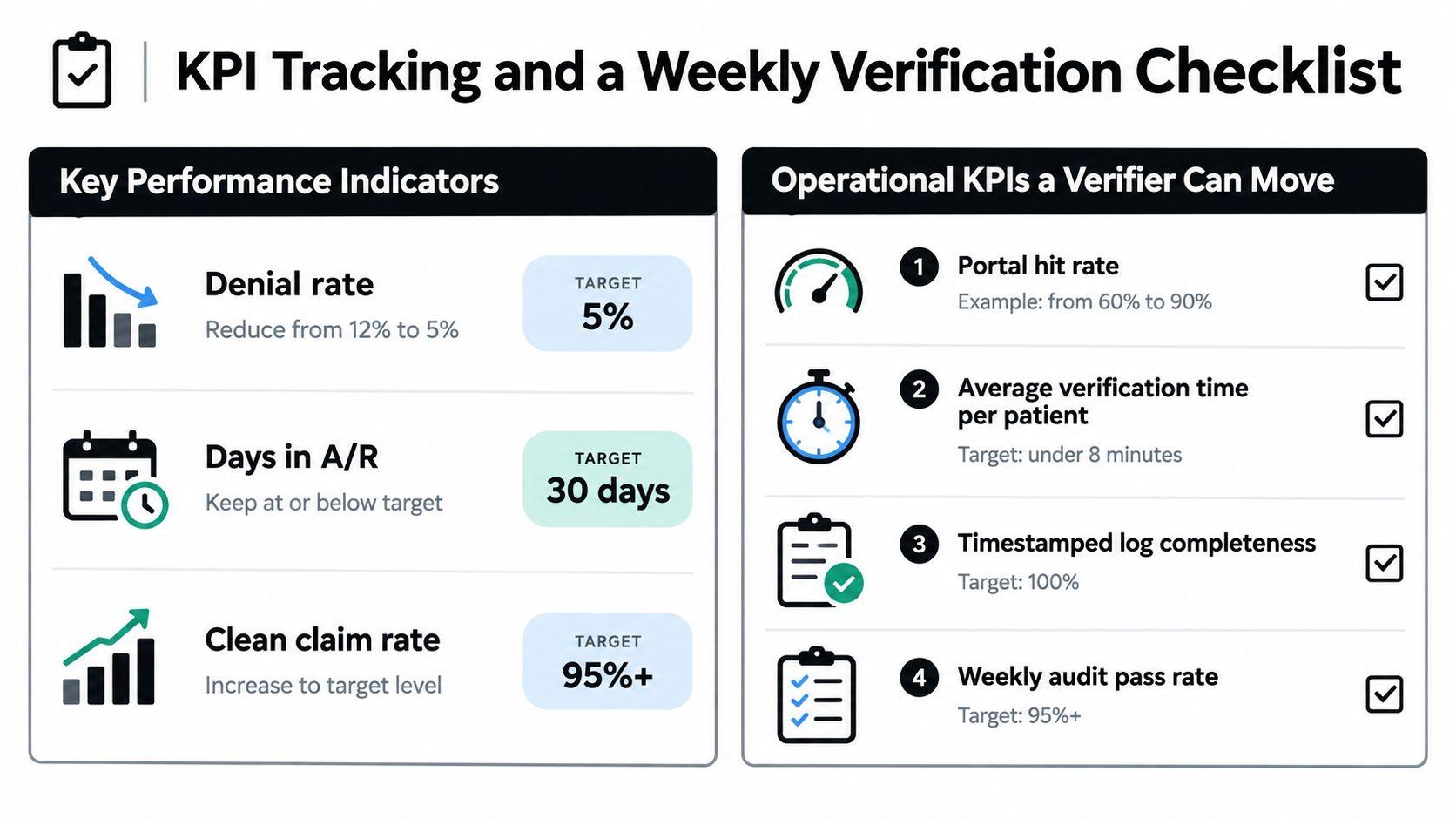
The metrics that belong to verification
A useful scorecard connects front-end performance to revenue outcomes without pretending the verifier controls everything.
Track these:
- Eligibility-related denial trend: Reviewed from remits and denial workqueues
- Days to rework verification failures: How long it takes to correct and resubmit accounts tied to front-end misses
- Write-off exposure tied to verification defects: Accounts that became uncollectible because the control failed
- Exception rate by checkpoint: How many accounts fail at scheduling, pre-visit, or check-in
- Evidence completeness rate: Whether the encounter has the required screenshot, 271 file, or call log
- Average verification time by payer or plan family: Useful for staffing and training
- Channel mix by payer: Whether staff are using the expected verification lane
A weekly operating rhythm that actually works
The strongest verification teams don't wait for month-end dashboards. They review misses every week and change scripts quickly.
A practical cadence looks like this:
Monday denial root-cause pull
Review the prior week's eligibility-related denials and separate true payer behavior from front-end defects.Midweek coaching
Pull a handful of real accounts. Show the staff exactly where the intake field failed, where the benefit detail was missed, or where the evidence packet was incomplete.Friday payer-quirk update
Refresh the rule library. If one payer changed portal behavior, referral logic, or network display, update the script and workqueue note before next week starts.
Working standard: If the same eligibility denial happens twice for the same reason, the process wasn't fixed. It was only discussed.
A one-page checklist teams can adopt now
Use a short checklist that supervisors can audit quickly:
- Required intake fields present before verification starts
- Primary and secondary coverage screened
- Scheduled service and location specified clearly
- Three checkpoint timestamps logged
- Verification channel recorded
- Portal screenshot, 271 trace, or call reference stored
- Authorization or referral status documented
- Exception accounts routed before service
- Evidence file naming convention followed
- Weekly KPI review placed on the operations calendar
A verification process becomes dependable when it stops living in individual memory. The minute you turn it into a repeatable control with evidence standards, exception routing, and weekly review, denials get easier to prevent and much easier to defend.
RevGuard helps provider groups turn insurance verification into a documented revenue protection workflow by tying eligibility checks, benefit validation, clean-claim readiness, and dispute support into one operating model. If your team needs stronger front-end controls, cleaner evidence for appeals, or tighter coordination between RCM and NSA dispute work, visit RevGuard to see how that process is built.