

Certified IDR entities issued 1,047,575 payment determinations in 2024, compared with 209,346 in 2023, proving that federal independent dispute resolution is now a primary reimbursement channel rather than a niche exception process. Providers should treat IDR as a revenue-cycle function, with eligibility controls before filing and payment controls after a decision.
The scale changed the operating model. IDR began as a legal remedy under the No Surprises Act, but it now behaves like national reimbursement infrastructure. A provider group that leaves IDR to occasional legal review is treating a recurring payment channel as an exception queue.
The practical question isn't whether your organization should use IDR. It's whether your claims, evidence, deadlines, and post-award collections are engineered well enough to make the process produce cash.
Why Federal Independent Dispute Resolution Matters Now
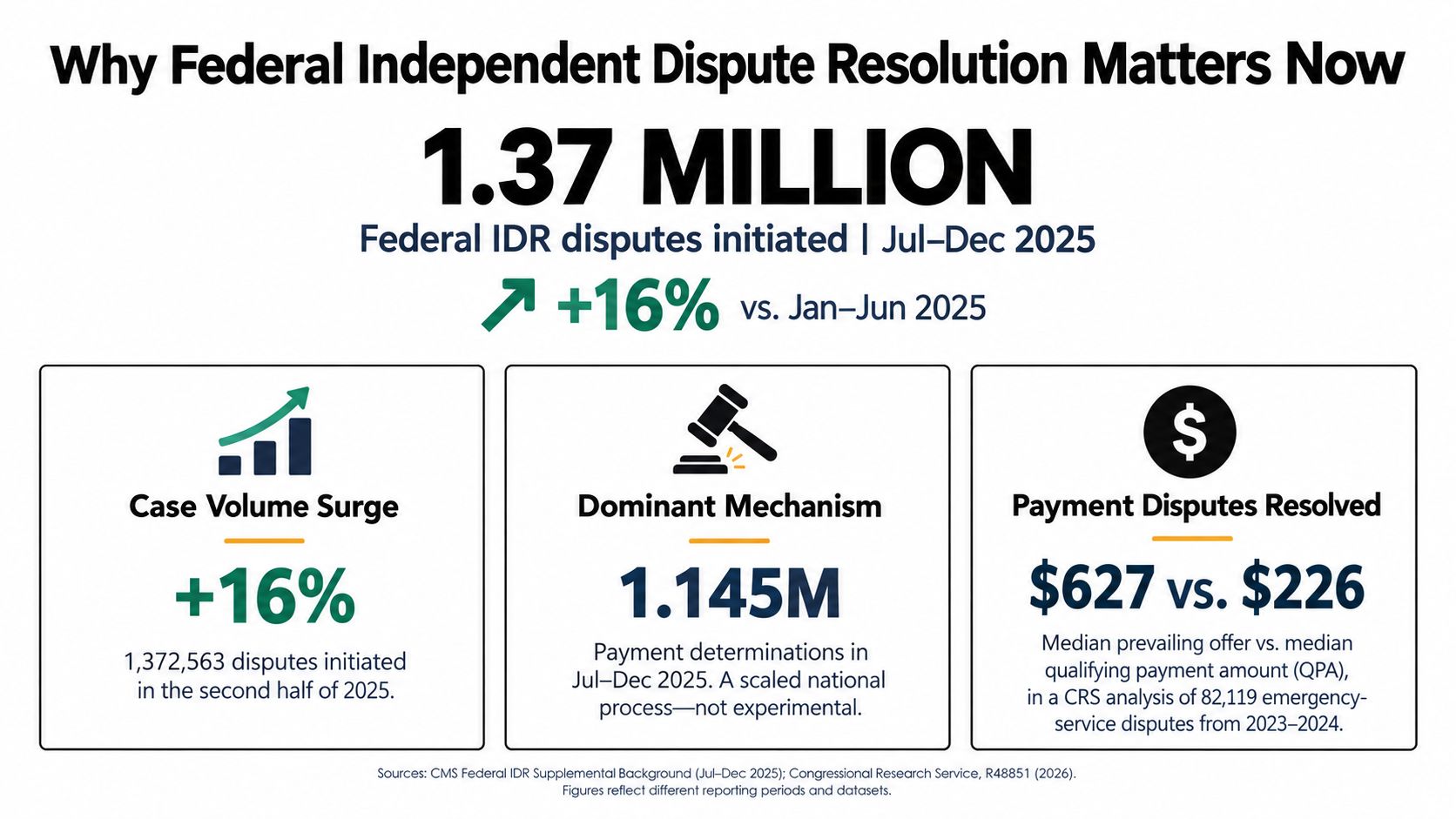
The federal IDR system moved from startup friction to industrial-scale reimbursement activity. Certified IDR entities rendered 1,047,575 payment determinations in 2024, compared with 209,346 in 2023, a 500% increase documented in CMS's 2024 federal IDR background report. The same report records 1,371,862 disputes closed in 2024, compared with 311,863 in 2023.
That isn't ordinary program growth. It changes how revenue-cycle leaders should allocate people, systems, and accountability. IDR has become a structural feature of commercial reimbursement across hospitals, physician specialties, emergency services, and air ambulance providers.
The Congressional Budget Office reports that approximately 3.4 million disputes were filed from 2022 through mid-2025, substantially exceeding the initial estimate of roughly 22,000 disputes per year in its analysis of the No Surprises Act. The forecast gap matters because it confirms that providers aren't using IDR only for unusual or high-profile conflicts. They're using it as a recurring mechanism to challenge payment outcomes.
The operational conclusion
Federal IDR became operational on April 15, 2022, when the Centers for Medicare & Medicaid Services opened the federal portal under the No Surprises Act. Its early period was difficult. Government agencies reported nearly 490,000 disputes submitted from April 2022 through June 2023, while approximately 61% remained unresolved as of June 2023, according to the Government Accountability Office's review.
The year 2024 was the first full calendar year in which the federal process operated without suspension. That distinction matters when interpreting the data. Early figures reflect litigation, eligibility questions, workflow constraints, and startup backlog. Later activity increasingly reflects a continuously operating arbitration infrastructure.
Practical rule: Treat IDR readiness like coding, eligibility, and payer contracting. It belongs in daily revenue operations, not in a drawer marked “legal escalation.”
Specialty groups and multi-state platforms need a defined owner for dispute intake, eligibility review, evidence assembly, filing deadlines, payment reconciliation, and payer reporting. Without that ownership, the organization may file more cases while recovering less net revenue.
How the Federal Independent Dispute Resolution Process Works
Federal IDR is closed-offer, baseball-style arbitration. After the parties complete the required open-negotiation period without agreement, the provider or payer submits a final payment offer. The certified IDR entity selects one offer. It doesn't calculate a compromise rate or build a third offer.
That structure creates a simple but demanding decision rule. Your package must make the provider's offer more defensible than the payer's offer under the statutory criteria. A persuasive clinical narrative alone won't overcome a mismatched code, service setting, participant type, or geographic area.
The decision rule
The Qualifying Payment Amount, or QPA, generally represents the insurer's median in-network rate for the same or comparable service and geographic area, adjusted for inflation. It often anchors the payer's position, but it isn't the only permitted evidence.
The arbitrator must consider statutory information and permitted evidence such as:
- Service complexity: Show why the item or service required a level of clinical effort that the payment doesn't reflect.
- Provider training: Document specialty qualifications and capabilities relevant to the disputed service.
- Market share: Present relevant market information when it supports the offer.
- Case mix: Demonstrate meaningful differences in patient acuity or service populations.
- Comparable contracted rates: Use relevant agreements and rate data, not broad market assertions.
Certain anchors, including billed charges and Medicare or Medicaid rates, are excluded from consideration. Providers should therefore avoid building a package around the amount originally billed or a comparison to public-program reimbursement.
The practical mechanics are summarized in this guide to arbitration rules. The key is to organize evidence around the exact claim and the exact offer, not around a general argument that the provider deserves better reimbursement.
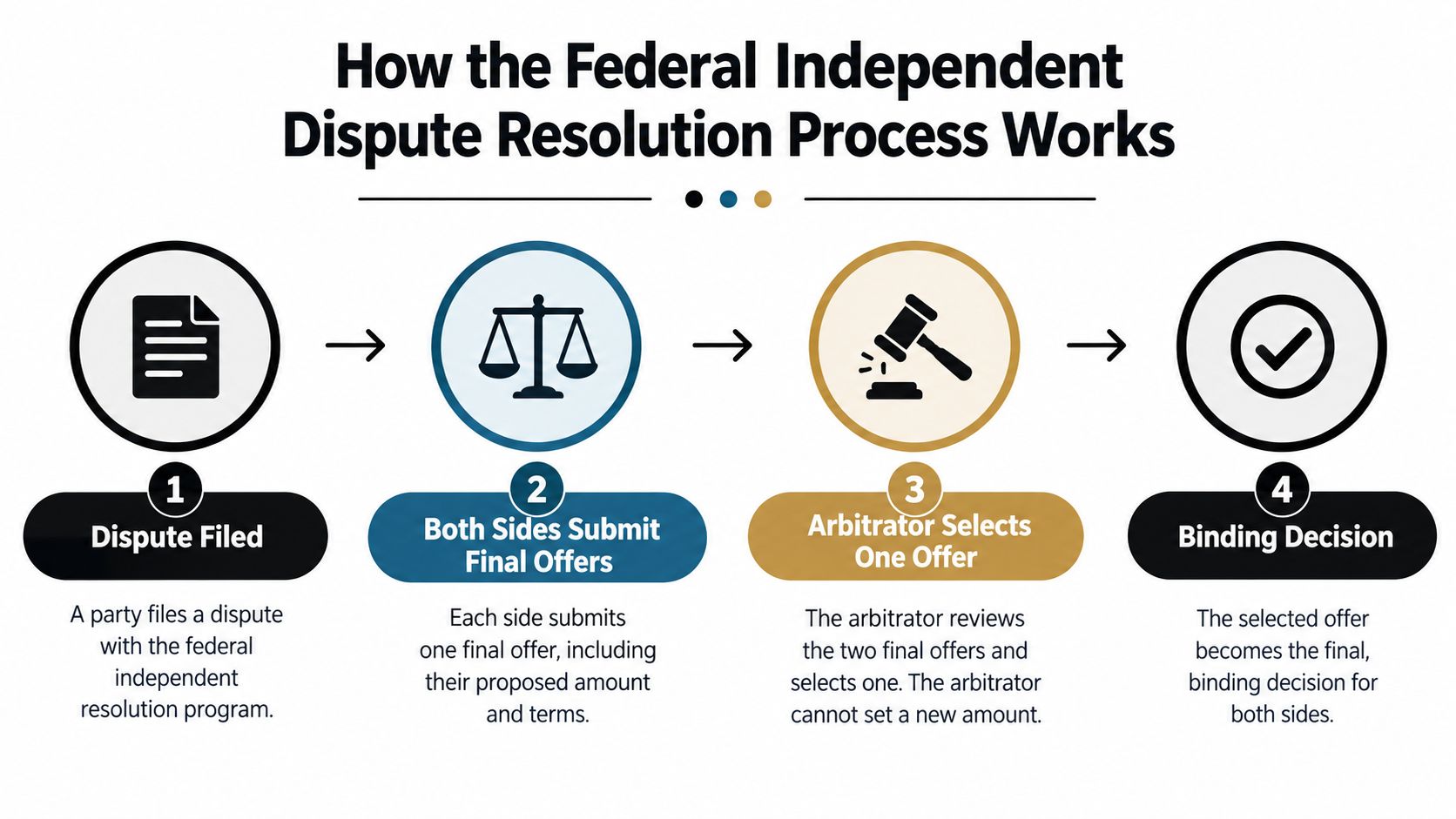
A clean process usually follows this sequence:
- Confirm the dispute exists. Verify the payment or denial and determine whether the No Surprises Act applies.
- Complete and document open negotiation. Preserve notices, dates, contacts, and payer responses.
- Submit final offers and evidence. Keep the offer consistent with the claim facts and the supporting record.
- Manage the determination. Record the decision, expected payment, fees, and follow-up obligations.
The system rewards precision. A clinically strong case can still fail if the administrative record doesn't connect the service to the offer.
Eligibility Triage and Filing Barriers
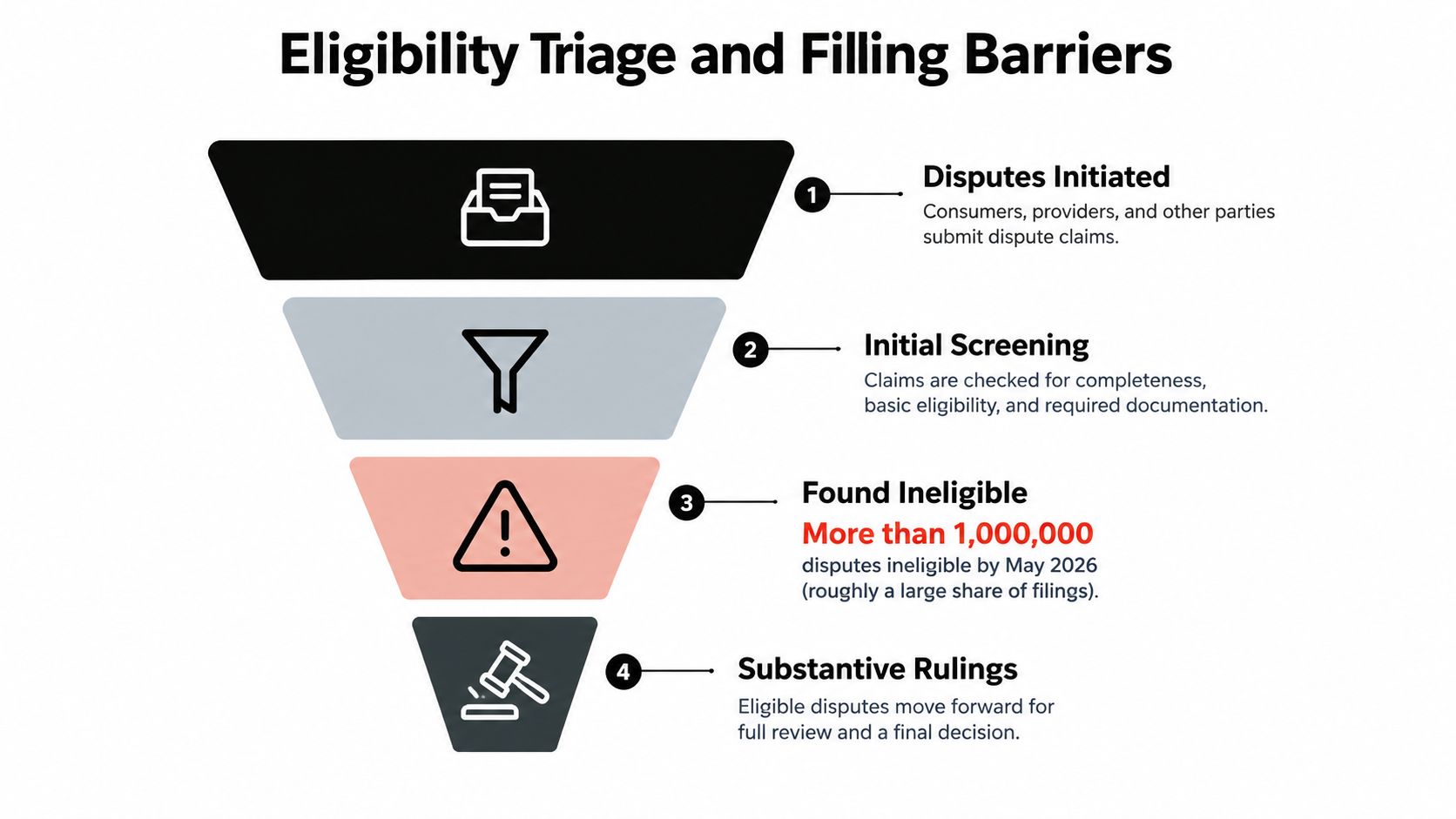
By May 2026, more than 1 million disputes had been found ineligible, about 16.8% of all disputes initiated since the program began, according to CMS's 2025 first-half supplemental background report. That is not a legal footnote. It is a revenue-cycle failure rate.
Treat eligibility as a front-end production control, not a filing step at the end. Every ineligible dispute burns analyst time, portal labor, documentation effort, and manager attention without creating collectible revenue. If your team wants better IDR yield, start by reducing bad submissions before they reach the portal.
The gate belongs upstream, while the claim is still in the hands of coding, contracting, and reimbursement. Ask one question early and answer it with the file in hand: can the record prove this claim belongs in federal IDR?
A disciplined triage should confirm:
- Coverage applicability: Verify that the service and plan belong in the federal process.
- Participant identity: Confirm the payer, provider, facility, and participant types on the claim.
- Service details: Check dates, codes, place of service, and related claim elements.
- Open negotiation record: Preserve evidence that the required negotiation step occurred.
- Batching logic: Split claims that do not qualify to be grouped together.
- Jurisdiction: Identify disputes that belong in another process instead of federal IDR.
Organizations lose recoveries they assume are still alive. A claim can be underpaid, clinically defensible, and still dead on arrival if the file cannot establish threshold eligibility. That makes IDR an engineering problem. The output depends on the quality of the inputs, the handoffs, and the controls.
Bundling mistakes are a common example. Teams often group services that look operationally related but fail under the batching rules, or they leave out claim-level facts needed to support eligibility. The dispute then fails before anyone reaches the payment argument.
The operational lesson is straightforward. Build a hard filing barrier with named owners for each field. Coding should validate the service. Contracting should confirm payer and participant facts. RCM should validate payment status and open-negotiation history. A designated IDR reviewer should confirm that the complete file can withstand eligibility review before submission.
That ownership model closes a familiar gap. One team assumes another verified eligibility, the dispute gets filed anyway, and the denial reason shows up too late to fix efficiently. Filing volume is a weak KPI unless you also track ineligibility rates, root causes, and repeat defects. The mature IDR programs do that work before submission, because clean claims produce better arbitration inventory and fewer avoidable losses.
Evidence Requirements and Offer Strategy
IDR rewards claim-level evidence engineering, not broad statements about underpayment. The provider's package should make it easy for the arbitrator to connect the billed service, the patient or operational circumstances, and the proposed payment.
Start with a source-of-truth claim file. Include the code, service date, place of service, participant details, payment history, open-negotiation record, and final offer. Then add the evidence that explains why the service belongs at the provider's proposed amount.
Build evidence around the service
For clinical specialties, that may include acuity, complexity, staffing, facility capability, specialty training, and case-mix information. For emergency and air ambulance providers, travel or transport factors can matter. For every dispute, the evidence should relate to the actual service rather than a generic description of the practice.
Comparable contracted rates can support the offer when they reflect a relevant service, setting, geography, and participant type. They shouldn't be presented as interchangeable with the disputed claim without explaining the comparison.
The QPA guidance for providers is useful as a practical checkpoint, but the operational task is broader than reviewing a single figure. Test whether the payer calculated the QPA using the correct:
- Code or comparable code
- Service setting
- Geographic region
- Participant type
- Time period and applicable adjustment
A QPA can look persuasive while still being technically wrong for the claim. Your response should identify the mismatch clearly, support the correction with claim-specific records, and avoid burying the point inside a long narrative.

Make the package reusable
Create modular evidence components that staff can update without rebuilding every file from scratch. A specialty capability section, facility description, acuity explanation, rate comparison, and payer-specific QPA audit can each become a controlled template with claim-level fields.
Don't confuse reuse with boilerplate. Reuse the structure, not unsupported language. The final package should show that someone reviewed the actual claim and selected evidence that addresses the actual offer comparison.
Offer strategy should follow the closed-offer design. The provider isn't asking the arbitrator to split the difference. It's presenting one amount and explaining why that amount is the stronger choice under the permitted evidence.
Cost Structure and Decision Modeling
A weak filing economics model will drain margin faster than a bad underpayment pattern. Treat federal IDR as a revenue-cycle engineering decision. Every case needs a disciplined estimate of net recovery after fees, labor, and the chance of winning.
Both parties generally pay the administrative fee, and the non-prevailing party generally pays the certified IDR entity fee. Those mechanics matter because gross variance alone is a poor filing trigger. A claim can look attractive on paper and still produce a bad return once analyst time, clinical review, escalation effort, and collection follow-up are counted.
Use an explicit expected-value model
Use a formula your team can apply the same way every time:
Expected value = probability of selecting the provider offer × incremental recovery − administrative fee − expected entity fee − internal preparation cost
Keep it simple, but make it real. The probability input should come from your own results by payer, specialty, code family, setting, and evidence pattern whenever possible. National outcomes help with context, but they do not price an individual dispute. As noted earlier, published program analysis shows provider offers were selected often in determined cases, yet that headline result does not fix weak documentation, a marginal variance, or a poor fit between the claim and the evidence presented.
Build the filing decision around operational variables your revenue-cycle team can control:
- Recovery size: Estimate the additional amount above the initial payment.
- Evidence strength: Score whether the record supports acuity, capability, service complexity, and comparable contracted rates.
- Eligibility confidence: Confirm the file is complete before anyone spends time drafting.
- Payer behavior: Track recurring QPA issues, response patterns, and payment conduct after disputes.
- Preparation burden: Count analyst, clinical, legal, and management time as a real cost.
Many teams lose money here. They measure award potential and ignore process cost. They also treat all disputes as if they consume the same effort, even though some payer patterns can be documented quickly and others require a full rebuild every time.
You do not need a committee on every file. You need thresholds, exception rules, and a queue design that sends high-value, well-supported disputes forward while routing marginal cases back into payer-specific root-cause work. That approach improves negotiations too. Teams that know the net value of escalation can set offers and settlement positions from a recovery model instead of reacting to every low payment.
Post-Award Compliance and Payment Collection
A favorable determination isn't the end of the revenue cycle. It's a new account-receivable control point.
CMS reported that more than 600,000 disputes were still awaiting determinations at the beginning of 2025, while 69% of open disputes were older than 30 business days at that checkpoint. By July 2025, 96.5% of submitted disputes were either resolved or less than 30 business days old, showing operational improvement, but resolution speed doesn't prove that every favorable amount was paid, posted, and reconciled. CMS documented the improvement in its fact sheet on clearing the IDR backlog.
Track the award through cash posting
The post-award workflow should create a control record containing the determination, selected offer, applicable fees, expected payer payment, remittance details, and collection status. The account shouldn't disappear from the IDR queue once the decision arrives.
Reconcile the determination against the remittance. Identify whether the payer paid the selected amount, paid partially, used an unclear explanation, or failed to pay. Then calculate the true net recovery after administrative fees, entity fees, internal labor, and any collection activity.
The organization should also track:
- Payment timing: When the amount was expected and when it posted.
- Variance: The difference between the selected offer and the remitted amount.
- Explanation quality: Whether the remittance supports reliable reconciliation.
- Escalation status: Which nonpayment issues require follow-up.
- Payer pattern: Whether similar payment problems recur across claims.
A win that never posts to cash is an unresolved reimbursement event, not a completed recovery.
Post-award data belongs in payer negotiations and contract strategy. If the organization counts determinations but not collected dollars, it may overstate IDR performance and understate payer noncompliance. Unresolved balances also weaken future negotiation positioning because leadership lacks a complete record of what the payer ultimately paid.
The right dashboard connects case outcome, fees, remittance, collection status, and repeat underpayment behavior. That is how a legal decision becomes a measurable revenue result.
Integrating IDR into Revenue Cycle Management
IDR works best when upstream RCM teams create dispute-ready claims before a payment conflict appears. Clean coding gives the dispute a reliable service foundation. Accurate credentialing supports the provider and participant facts. Payer contracting supplies relevant rate comparisons. Claim-level documentation explains complexity and capability.
These functions shouldn't operate as separate handoffs. Each one affects the next.
Connect the controls
A practical operating model links:
- Coding to evidence: The code, modifier, setting, and service description must match the supporting record.
- Eligibility to jurisdiction: Coverage and participant facts should be validated before open negotiation.
- Credentialing to offer strategy: Specialty training and facility capability need accurate source documentation.
- Contracting to QPA review: Contract and rate data should help test the payer's calculation.
- AR to enforcement: Determinations must flow into payment posting, reconciliation, and escalation.
CMS recorded 1,082,247 payment determinations in the first half of 2025, approximately 55% more than the 698,968 determinations in the last half of 2024, according to the Congressional Research Service report. At that volume, manual tracking and informal deadline reminders create preventable risk.
Automation should handle intake, field validation, deadline controls, document assembly, status changes, and reporting. Human reviewers should focus on disputed eligibility, evidence quality, offer positioning, and exceptions that require judgment.
Specialty practices, air ambulance providers, ASCs, and multi-state platforms gain more from preventing defective disputes than from filing every marginal case. A clean claim that never requires escalation is often more valuable than a poorly prepared dispute that consumes fees and staff time.
For organizations assessing broader revenue-cycle optimization, IDR performance should sit inside total reimbursement yield. Measure initial payment, incremental recovery, fees, preparation cost, collection completion, and payer behavior together.
RevGuard is one example of a service model that connects specialty RCM with IDR strategy, evidence assembly, filing, enforcement, collections, and payer analytics. The important design principle isn't the vendor label. It's the integration of upstream claim controls with downstream recovery.
Putting It All Together
Consider a specialty group that receives an out-of-network payment below its expected contracted benchmark. The team doesn't send the claim straight to an arbitration queue. Coding confirms the service and setting, eligibility staff verify that the No Surprises Act applies, and RCM preserves the open-negotiation record.
The group then builds a claim file with acuity, staffing, specialty capability, facility facts, and relevant rate comparisons. An analyst tests the payer's QPA for code, setting, geography, and participant type. The group models expected recovery against administrative fees, possible entity fees, and internal preparation time before approving the filing.
The final offer is supported by evidence tied to the actual service. The file doesn't rely on billed charges or public-program rates, and it doesn't ask the arbitrator to invent a compromise. It presents one defensible amount under the closed-offer structure.
After the determination, the work continues. The team records the selected offer, forecasts the net recovery, watches the remittance, reconciles the posted amount, and escalates any shortfall. The result enters the payer-performance dashboard alongside similar disputes, showing whether the issue is isolated or part of a recurring underpayment pattern.
That workflow changes the question from “Did we win IDR?” to “Did this claim produce recoverable net revenue, and did the process prevent the next avoidable loss?” Federal independent dispute resolution succeeds when eligibility, evidence, economics, deadlines, and collections operate as one revenue system.
RevGuard connects specialty RCM with federal IDR strategy, evidence preparation, filing, enforcement, collections, and payer-behavior reporting. If your organization needs to turn dispute readiness into a controlled revenue workflow, visit RevGuard to discuss the full lifecycle.