

A specialty clinic can do everything right clinically and still lose revenue before the claim reaches the payer. A patient arrives for a planned procedure, the insurance card looks current, and the policy returns as active. Later, the claim is denied because the procedure requires authorization, the facility is out of network, or the patient's benefit excludes that site of service.
That situation frustrates front-desk teams, billing specialists, clinicians, and patients alike. Staff must investigate the denial, contact the payer, correct records, resubmit the claim, and explain an unexpected balance. The patient may have believed that active coverage meant the procedure was payable.
Insurance verification is the control that helps prevent this chain of events. It connects accurate registration data with benefit rules, authorization requirements, network details, patient estimates, and claim preparation. For specialty practices, it's not merely a check-in task. It's an early revenue-protection step.
Introduction to Insurance Verification
Consider an orthopedic practice preparing for an outpatient procedure. The patient's policy appears active, but the team doesn't confirm that the planned procedure is covered at the selected facility. No one checks whether the surgeon and anesthesia provider participate in the same network, and the authorization requirement remains unclear.
The appointment proceeds. The payer later rejects the claim because the service needed prior authorization or because a relevant provider was out of network. The billing team now has to reconstruct what happened, while the patient receives a balance they didn't expect.
This is why what is insurance verification can't be answered with “checking whether insurance is active.” Verification confirms coverage on a particular date and identifies the financial and utilization rules attached to the planned service. A reliable process helps teams identify exclusions, deductibles, copayments, coinsurance, authorization requirements, and network limitations before care is delivered.
The work also protects the patient experience. Staff can explain known coverage conditions, request missing information, and escalate uncertainty instead of allowing a preventable issue to appear after treatment. In a specialty setting, that early attention supports cleaner claims, fewer avoidable corrections, and more predictable revenue.
What Insurance Verification Entails
Insurance verification is a structured, pre-service review of a patient's coverage and benefits. The reviewer confirms whether coverage is active for the intended date of service, then examines whether the specific service is covered and under what conditions. The review may include benefit categories, exclusions, cost-sharing, network status, referrals, authorization rules, and service-specific limitations.
The process is usually performed by front-desk staff, patient-access representatives, billing specialists, centralized revenue-cycle teams, or outsourced verification teams. The person completing the check may differ by organization, but the responsibility should be clear. Someone must own the result, document it, and route unresolved issues before the appointment or procedure.
In the United States, the electronic foundation is the HIPAA ASC X12N 270/271 transaction. A provider or authorized intermediary submits a 270 eligibility and benefit inquiry, and the health plan returns a 271 response containing coverage information. CMS identifies the 270/271 transaction set as the federally recognized electronic standard under 45 CFR 162.
Verification is not a payment guarantee
An active policy generally confirms enrollment. It doesn't guarantee that the payer will reimburse a particular claim. Payment can still depend on medical necessity, coding, documentation, authorization, provider participation, exclusions, and claim adjudication.
Practical rule: Treat an eligibility response as a point-in-time finding, not a promise of payment.
For a specialty practice, the useful output is more than “active” or “inactive.” It's a documented answer to a series of operational questions: Is the patient covered on the planned date? Is the procedure included? Is authorization required? Are all relevant providers and the facility in network? What cost-sharing rules apply? What evidence supports the answer?
Essential Data Points in Verification
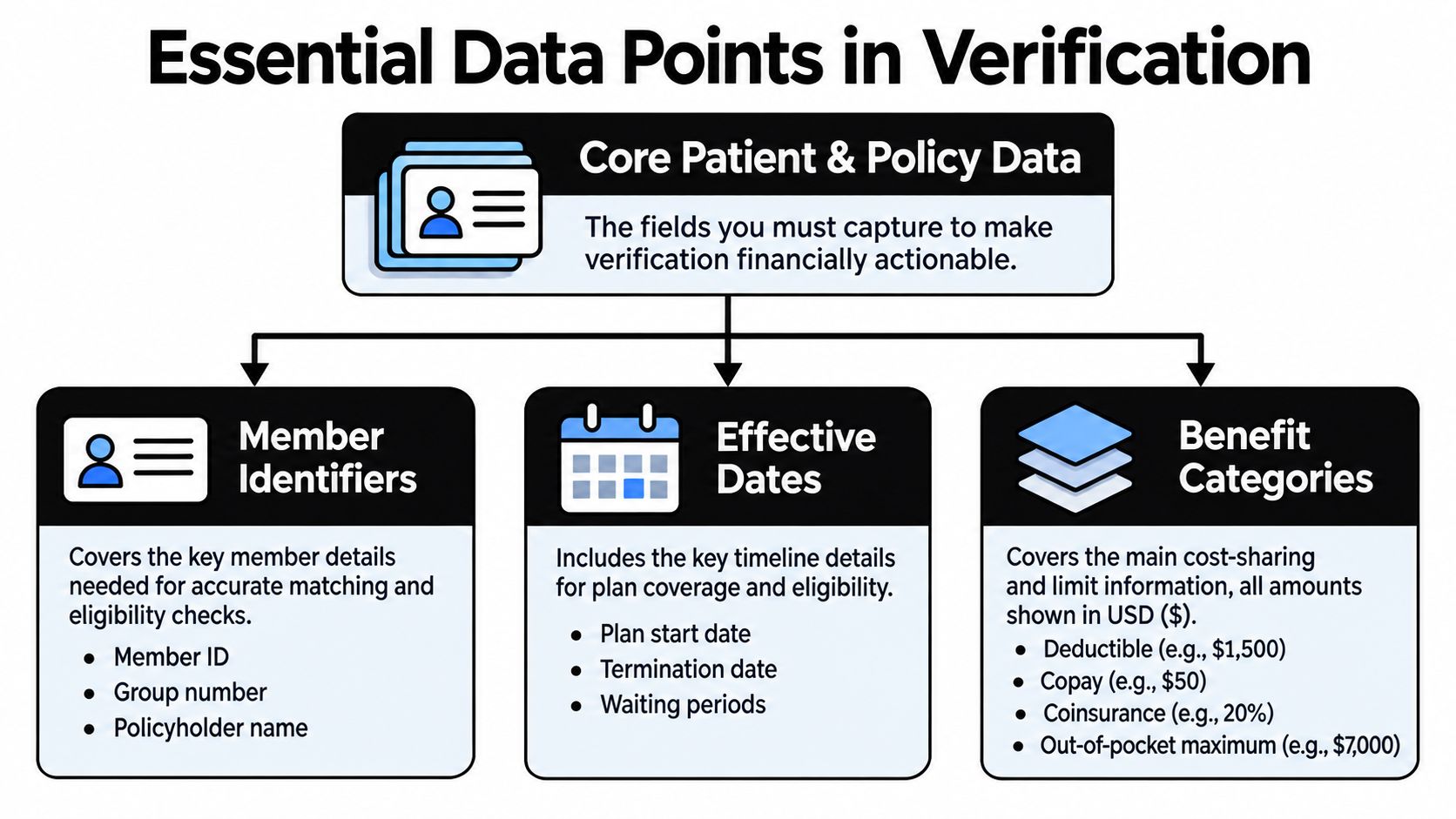
Think of verification as building a stable structure. Patient and policy identifiers form the foundation. Benefit and utilization rules form the middle. Documentation and exception handling provide the support that lets the result guide scheduling, estimates, authorization, and billing. If one layer is missing, the final answer may look complete while remaining financially unreliable.
Start with the identity and policy fields. Match the patient's legal name, date of birth, member ID, group number, subscriber name, and relationship to the subscriber. Confirm that the information in the practice-management system matches the card and the payer response. A small mismatch can send a valid inquiry toward an unusable result or create claim edits later.
Next, check time-sensitive coverage information. Record the effective date, termination date when available, and any waiting-period or coverage limitation information relevant to the planned service. A response that was accurate during scheduling may no longer reflect the patient's status on the procedure date.
Then examine the benefit layer:
- Benefit category: Confirm that the planned procedure or service falls within a covered category.
- Cost sharing: Record the applicable copayment, deductible, coinsurance, and out-of-pocket maximum information.
- Limits and exclusions: Look for frequency limits, exclusions, medical-necessity conditions, and site-of-service restrictions.
- Network participation: Check the facility and every relevant clinician, including surgeons, anesthesiologists, radiologists, or other specialists.
- Utilization controls: Identify referral and prior-authorization requirements for the exact service, provider, location, and date.
- Coordination of benefits: Determine whether another plan may be primary and document the payer sequence.
CMS's explanation of the 270/271 exchange supports treating verification as a structured pre-service process rather than an informal phone call. The response should be stored with its timestamp, the identifiers used, relevant benefit details, authorization information, and any payer reference number.
Common Pitfalls and How to Avoid Them
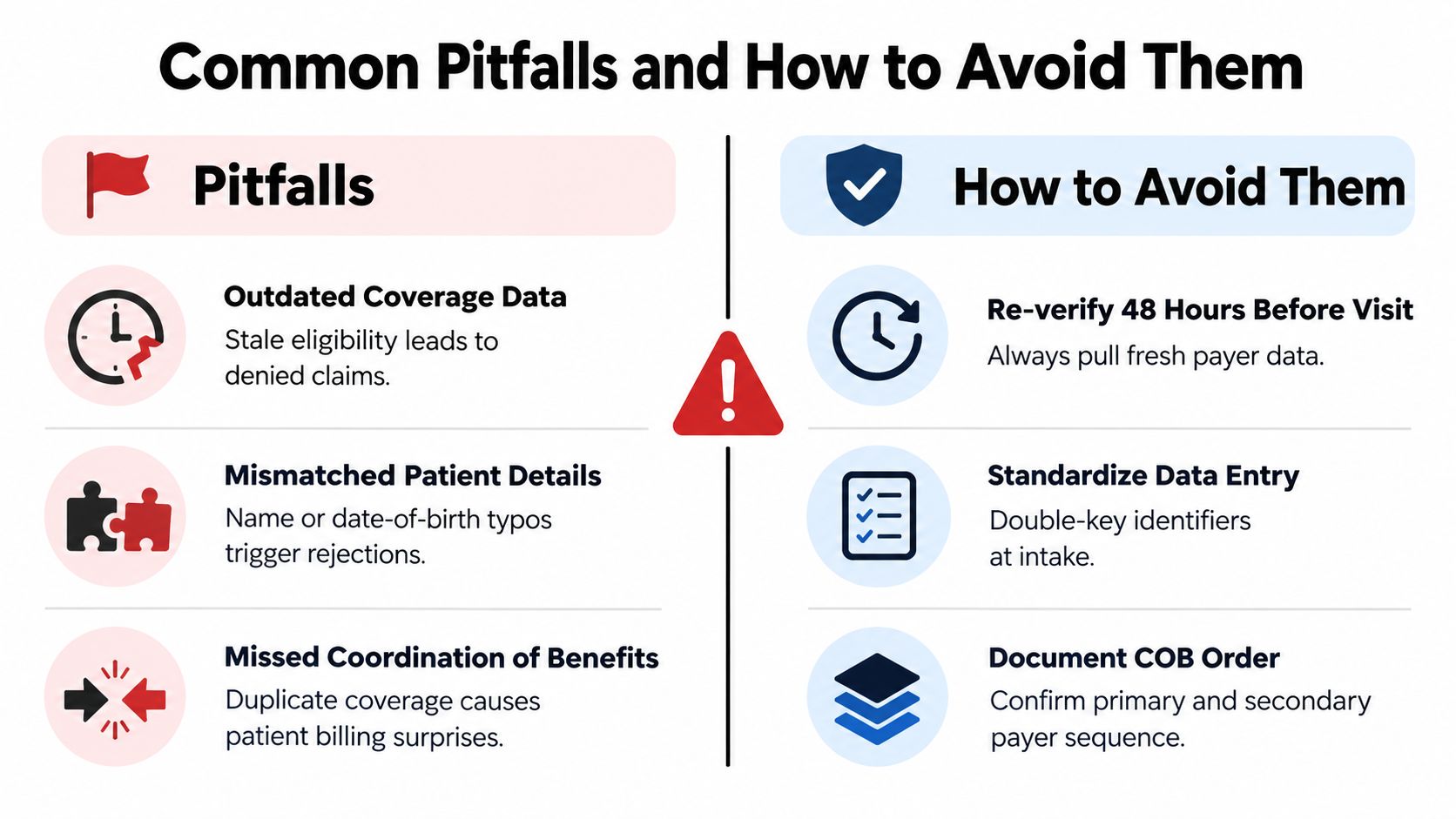
Most verification failures come from treating a changing, multi-part process like a single lookup. A team may confirm active coverage but miss a benefit exclusion. It may verify the patient's plan but use an incorrect member ID. It may capture a valid response too far in advance and never recheck it.
Outdated coverage data
Coverage can change between scheduling and treatment. Employer changes, plan-year changes, termination, retroactive eligibility decisions, and coordination-of-benefits updates can all affect the final claim. Rechecking near the date of service is especially important for recurring care and high-cost procedures.
Incomplete benefit review
An active plan can still exclude a procedure, impose frequency limits, require medical-necessity documentation, or depend on prior authorization. The reviewer should compare the planned service with the payer's benefit and utilization response, not stop at the eligibility status.
Incorrect registration details
Incomplete or incorrect registration data was identified as a primary denial trigger by 32% of respondents, while 50% cited missing or inaccurate claim data at intake in Experian Health's 2025 State of Claims survey. Experian Health's claims-acceptance guidance links these intake problems to downstream denial risk.
Use standardized data-entry rules, compare identifiers against the card, and route mismatched results to manual review. Don't allow a staff member to override an exception without recording why.
The administrative scale explains why small errors matter. CAQH estimates approximately 30 billion eligibility and benefit checks annually, with 94% using the HIPAA electronic standard. It also estimates $42 billion in annual industry spending on eligibility and benefit verification, with providers responsible for 98% of that spending. CAQH's transaction analysis shows why verification deserves measurable controls rather than informal ownership.
For a broader view of how front-end eligibility problems affect denials, review health insurance claim denial rates.
Step-by-Step Verification Workflow
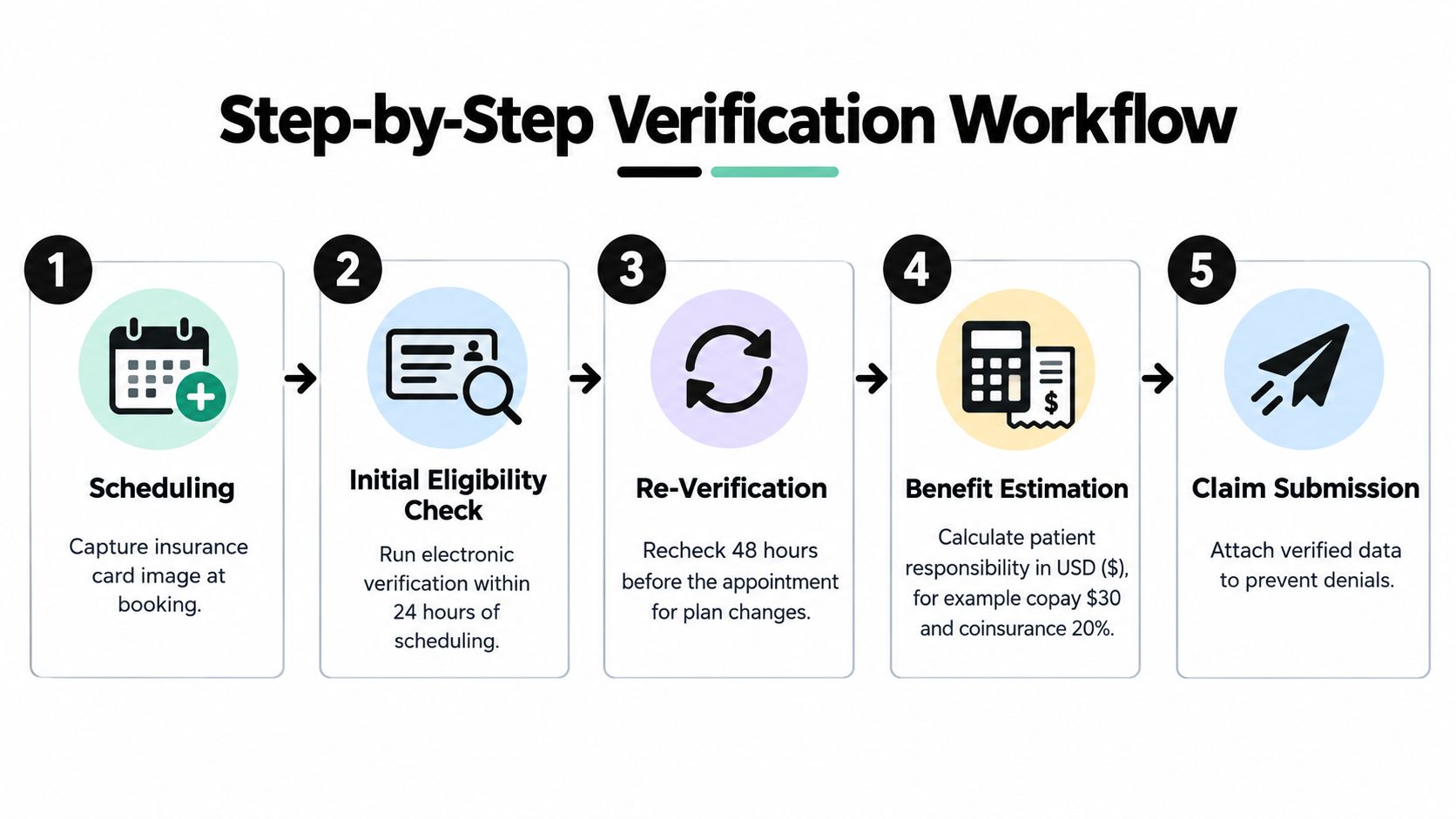
A dependable workflow gives each verification activity a place, an owner, and an audit trail. The exact timing can vary by specialty and payer mix, but the process should begin before care is delivered and include a deliberate recheck when coverage risk is high.
1. Capture complete information at scheduling
Collect the insurance card, patient demographics, subscriber details, group number, member ID, and planned service information. If the appointment involves multiple clinicians or a facility, identify each billing entity that may need separate network or benefit confirmation.
The service description matters. A generic “procedure” inquiry may not reveal the rules attached to the actual treatment, location, or provider.
2. Run the initial eligibility and benefit inquiry
Submit the 270 electronically when available, or use the payer's approved portal or telephone process when electronic data is unavailable. Review the 271 response for active coverage, effective dates, benefit categories, cost sharing, exclusions, network status, referrals, and prior authorization.
Don't treat an automated response as self-explanatory. Route unclear messages, missing benefit details, and conflicting payer information to a trained reviewer.
3. Confirm authorization and service conditions
Compare the planned procedure, site, rendering provider, and date with authorization requirements. Record the authorization number, submission status, approved service details, and expiration information when applicable.
A referral or authorization that applies to one provider or service may not automatically apply to another. That distinction is especially important for surgery, imaging, anesthesia, oncology, and recurring specialty treatment.
4. Re-verify at a defined checkpoint
Verification is a point-in-time control, not a one-time task. Recheck before elective care, recurring treatment, admission, a procedure date, a payer or employer change, or claim resubmission after a denial. High-risk accounts should receive additional review when the first response was incomplete or the patient's coverage is unstable.
The team should define who reviews the new response and what happens when it differs from the earlier result. A changed answer should trigger updated authorization work, patient communication, scheduling review, or financial-estimate correction.
5. Save the evidence and reconcile systems
Store the inquiry timestamp, payer response, identifiers submitted, benefit findings, authorization details, representative reference number, and reviewer notes. Reconcile the result with the practice-management system, electronic health record, scheduling record, authorization work queue, and claim edits.
A verification result has operational value only when downstream teams can find it and understand what it means.
Use exception queues for inactive coverage, mismatched identifiers, unknown network status, missing authorization, and conflicting coordination-of-benefits information. For organizations evaluating specialized support, medical eligibility verification describes the type of documented front-end workflow that connects eligibility with later claim readiness.
Examples and Impact on Clean Claims and Revenue Protection
A useful example doesn't need a dramatic recovery figure to show the value of verification. Consider a gastroenterology practice scheduling an outpatient procedure. The patient's plan is active, but the team checks only eligibility. It misses a site-of-service condition and doesn't confirm whether the facility participates in the patient's network.
The denial arrives after the procedure. Billing staff must investigate the facility contract, review the payer response, contact the patient, and determine whether a corrected claim or appeal is possible. The original error began before treatment, but the labor appears later across scheduling, billing, coding, patient accounts, and management.
A stronger workflow would have separated the questions:
- Is the patient enrolled on the date of service?
- Is the procedure covered under the benefit category?
- Does the planned site of service meet the plan's rules?
- Are the facility and clinicians participating?
- Is prior authorization required?
- What documentation and coding conditions apply?
- What patient responsibility can be explained before care?
This approach supports a clean claim, meaning the claim contains the information needed for the payer to process it without avoidable correction or clarification. RevGuard's explanation of a clean claim places front-end accuracy within the broader revenue-cycle process.
Specialty scenarios require more than an active response
An anesthesia group may need to verify its own participation separately from the hospital or surgeon. An imaging center may need to check whether the requested modality is covered at the selected location and whether authorization attaches to the exact procedure. An air-ambulance provider may need to document eligibility and benefit findings carefully because emergency circumstances, network questions, and later payment disputes can create complex records.
These examples don't mean verification can guarantee reimbursement. A patient can have active coverage while a procedure remains excluded, limited by frequency, subject to medical necessity, dependent on site of service, or payable only after authorization. Aetna Better Health's provider guidance separates eligibility, benefit coverage, prior authorization, and fee-schedule status, illustrating why a simple active response is incomplete. The 2025 Aetna Better Health guidance supports documenting each category distinctly.
For practice managers, the operational lesson is to connect verification outputs to the next decision. Scheduling needs an exception status. Authorization staff need the service and payer rules. Clinicians may need documentation prompts. Billing needs the verified identifiers, network findings, and supporting record. Patient financial services needs a defensible explanation of known cost-sharing conditions.
That connection protects more than claim acceptance. It gives the organization a record to use when investigating denials, responding to patient questions, reviewing underpayments, and assessing whether payer behavior warrants further escalation. Verification becomes a source of evidence, not a forgotten portal result.
Conclusion and Next Steps
Insurance verification is the first financial control in the revenue cycle. It confirms coverage at a point in time, but a complete review also examines benefits, exclusions, cost sharing, network participation, referrals, authorization, coordination of benefits, and service-specific rules.
Practice managers can strengthen the process by taking practical steps:
- Audit the current workflow: Identify where staff collect insurance data, who performs the inquiry, and where responses are stored.
- Standardize the required fields: Include identifiers, dates, benefit details, authorization findings, network status, timestamps, and reference numbers.
- Define re-verification triggers: Use procedure dates, recurring care, payer changes, incomplete responses, and claim resubmissions.
- Create exception ownership: Route mismatches and unresolved payer responses to named staff instead of leaving them in an unassigned queue.
- Measure downstream results: Track response completeness, manual-review volume, authorization delays, eligibility-related denials, and patient-balance corrections.
The right technology can support electronic inquiries, work queues, documentation, reconciliation, and reporting, but automation won't replace a clear policy for interpreting exceptions. Your team still needs to decide what makes a result financially actionable and what requires human review.
RevGuard provides documented eligibility and benefits verification as part of a specialty-focused revenue-cycle workflow, connecting front-end coverage checks with clean-claim preparation and payment follow-up. Visit RevGuard to see how your practice can turn insurance verification into a structured revenue-protection control.